Use case: SaaS
Cookie consent for SaaS products
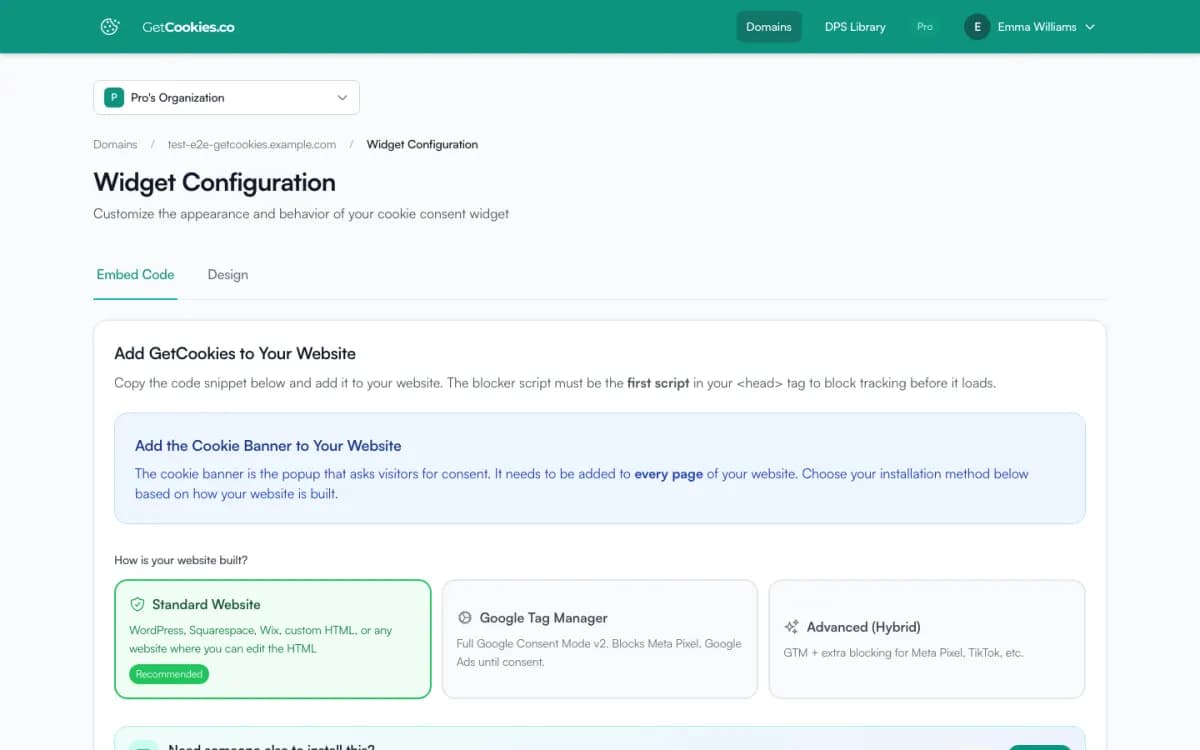
A SaaS company usually has a marketing site, a web app and a stack of analytics and product tools. GetCookies handles consent on both, keeps working across client-side route changes, and gives your developers an API to react to consent in code.
What SaaS teams need
One decision across your domains
Cross-domain consent (Pro and above) shares a visitor's choice between domains you own, such as your marketing site and app.
Single-page apps
Blocking keeps working across client-side navigation in React, Next.js and similar frameworks. See the single-page apps guide.
Consent in your own code
The JavaScript API lets you read consent and listen for changes before starting product analytics or chat widgets.
Strict Content Security Policies
Allow the GetCookies script and styles in your CSP with the CSP guide.
Automation
On Business and above, the REST API and signed webhooks let you sync consent events into your own systems.
Which plan fits
Teams with one marketing site and one app domain usually start on Pro for cross-domain consent and the advanced Consent Mode settings. Business adds the Consent Verification API and webhooks; see developers. Prices are on the pricing page.
Limits to know
GetCookies covers websites only; there is no SDK for consent inside native iOS or Android apps. If you need one, a CMP with a mobile SDK such as Usercentrics may suit you better; see GetCookies vs Usercentrics.
Best for, and not the best fit
Best for
SaaS companies with a marketing site and a web app that want one consent decision across both and want developers to read consent in code.
Best for
Teams on React, Next.js or other single-page apps that need blocking to keep working across client-side route changes.
Not the best fit
Products that need consent inside native iOS or Android apps; GetCookies has no mobile SDK.
Not the best fit
Teams that require EU-only hosting: GetCookies runs in the United States (Railway) behind Cloudflare, with Standard Contractual Clauses. See security.
Pricing for SaaS teams
SaaS teams usually choose by whether they need cross-domain consent and server-side access to consent records.
| Plan | Price | Domains | Why this plan |
|---|---|---|---|
| Starter | EUR 9 per month | 3 | Marketing site and app on up to 3 domains, with custom branding and CSS. |
| Pro | EUR 29 per month | 5 | Cross-domain consent between your marketing site and app, Consent Mode region detection and banner A/B tests. |
| Business | EUR 79 per month | 50 | The Consent Verification API, signed webhooks and unlimited banner languages. |
Prices in euro from the live plan list, billed monthly; annual billing costs less. Full pricing and limits
Frequently asked questions
Does GetCookies work with Next.js and other single-page apps?
Yes. Load the script before your app; blocking keeps working across client-side navigation. See the single-page apps guide.
Can our backend check whether a visitor consented?
On Business and above, the Consent Verification API looks up consent by the visitor id from window.GetCookies.getVisitorId(). See developers.
Is there a mobile SDK?
No. GetCookies covers websites and web apps only.
Where is consent data hosted?
In the United States (Railway), behind Cloudflare, with Standard Contractual Clauses. Details are on the security page.
Try GetCookies on your own site
Start on the Free plan: one domain, a cookie scan and a consent banner, no credit card required. Upgrade only when you need more.
Gratis beginnen